One Trip, Three Screens
Unify resort check-in, guest preferences and the cabin display.
First proof
Test a local mock-up and fallback without a phone or network.
Each is an independent IDEA ONE proposal for discussion, informed by the company’s published work. No brand has agreed to participate. These original sketches are not manufacturer designs.
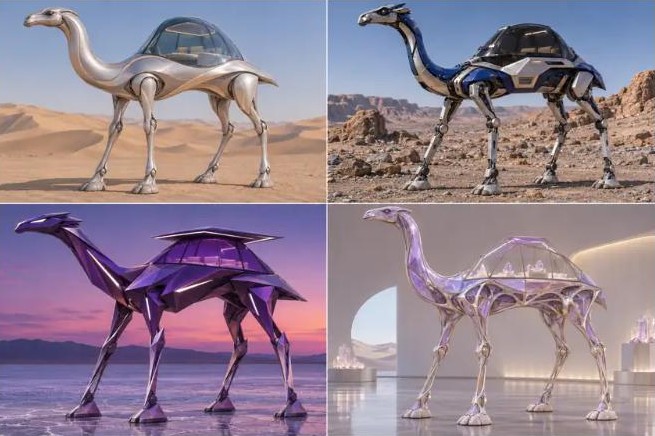
Connected experiences
Unify resort check-in, guest preferences and the cabin display.
First proof
Test a local mock-up and fallback without a phone or network.
Explain how route choices may affect comfort and energy use.
First proof
Replay a synthetic route; later compare with instrumented runs without passengers.
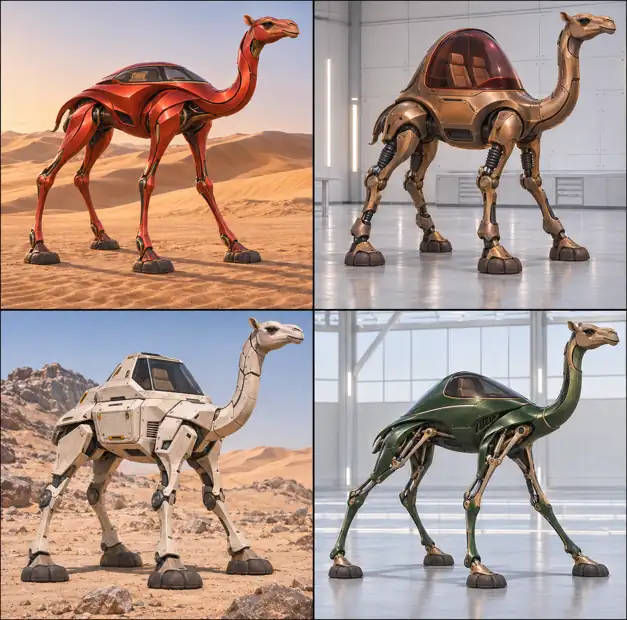
Expressive crossover design
Give the cabin an original sloping roofline and visibly separate walking legs.
First proof
Use a stationary mock-up to check boarding, seating, visibility and glare.
Pair a stationary exhibit with a separate tabletop model of the gait.
First proof
Measure how quickly visitors understand the concept and whether operators follow up.
Sculptural GT design and ride composure
Shape a private, panoramic lounge for two using original surfaces.
First proof
Check sightlines, shade and exit access in a stationary cabin mock-up.
Explore passive isolation to reduce cabin movement on uneven terrain.
First proof
Compare tilt and vibration against a rigid baseline using ballast, without passengers.
Measured terrain clearance and endurance
Design separate boarding and travel clearances around a surveyed route.
First proof
Check access on a stationary rig and test clearance on a closed route without passengers.
Prioritize inspection, protected internals and easy-to-service modules.
First proof
Repeat unmanned loops and log stoppages, sand ingress and service time.
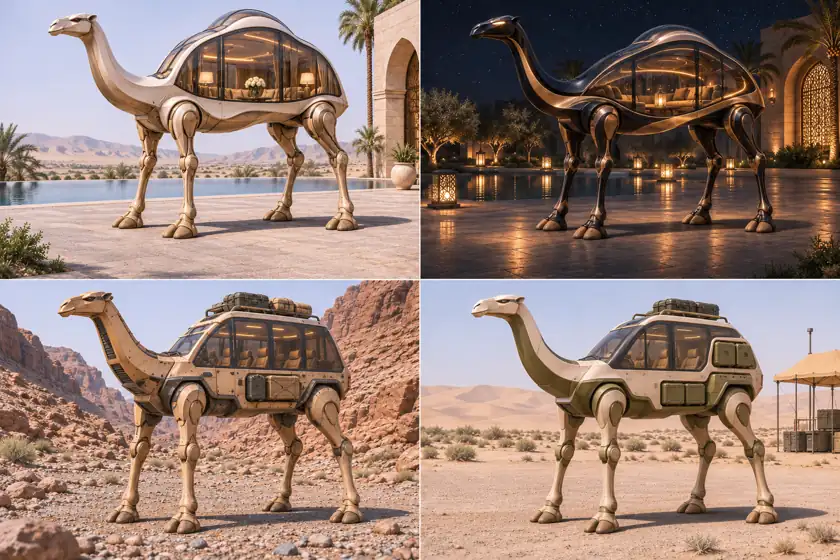
Private commissions and material craft
A stationary camel sculpture with a pale shell and a timber spine that conceals a slowly moving hump.
First proof
Test a bench-scale hump mechanism with no rider.
An abstract lounge pavilion with two humps that lift into illuminated canopies only when the space is empty.
First proof
Test one canopy and verify that it cannot move while occupied.
Field utility and terrain awareness
A slow cargo quadruped with broad padded feet and removable panniers shaped like camel humps.
First proof
Test one foot and a loaded pannier on a contained terrain rig.
A stationary field pod shaped like a resting camel, with separate humps for tools and a retractable crew marker and shade.
First proof
Measure access and setup time in a supervised mock setup.
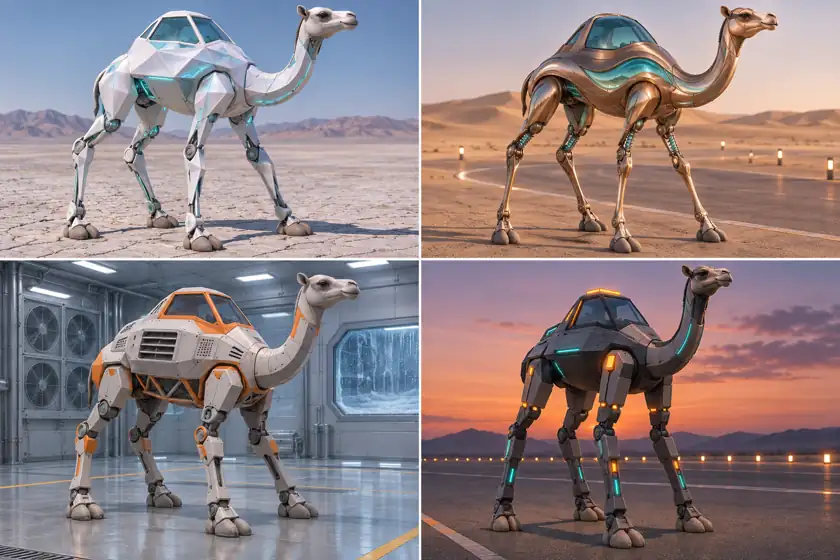
Distributed electric control
An electric four-legged demonstrator that shifts weight slowly through individually guarded joints.
First proof
Begin with an instrumented single-leg rig; no jumps or riders.
A stationary kinetic camel whose three overlapping aluminium shells turn in sequence and reflect a ripple of light.
First proof
Prototype one articulated shell behind a clear guard.
Potential engineering supplier, not an automaker
An instrumented closed-cabin study: cooling, battery and auxiliary loads, filtration, and failures in heat and dust.
First proof
Engineer-led bench test against the stock HVAC baseline, with no passengers.
A supplier study for sensor visibility, fault logging and independent validation in a controlled test enclosure.
First proof
Replay simulated visibility and sensor faults before controlled non-passenger tests.
One line is enough. Vladimir Uzbek, the founder, brings the full project to the meeting.